← Back to home

Advanced ankle osteoarthritis

Total ankle replacement

Replacing damaged joint surfaces to relieve pain while preserving useful ankle motion.

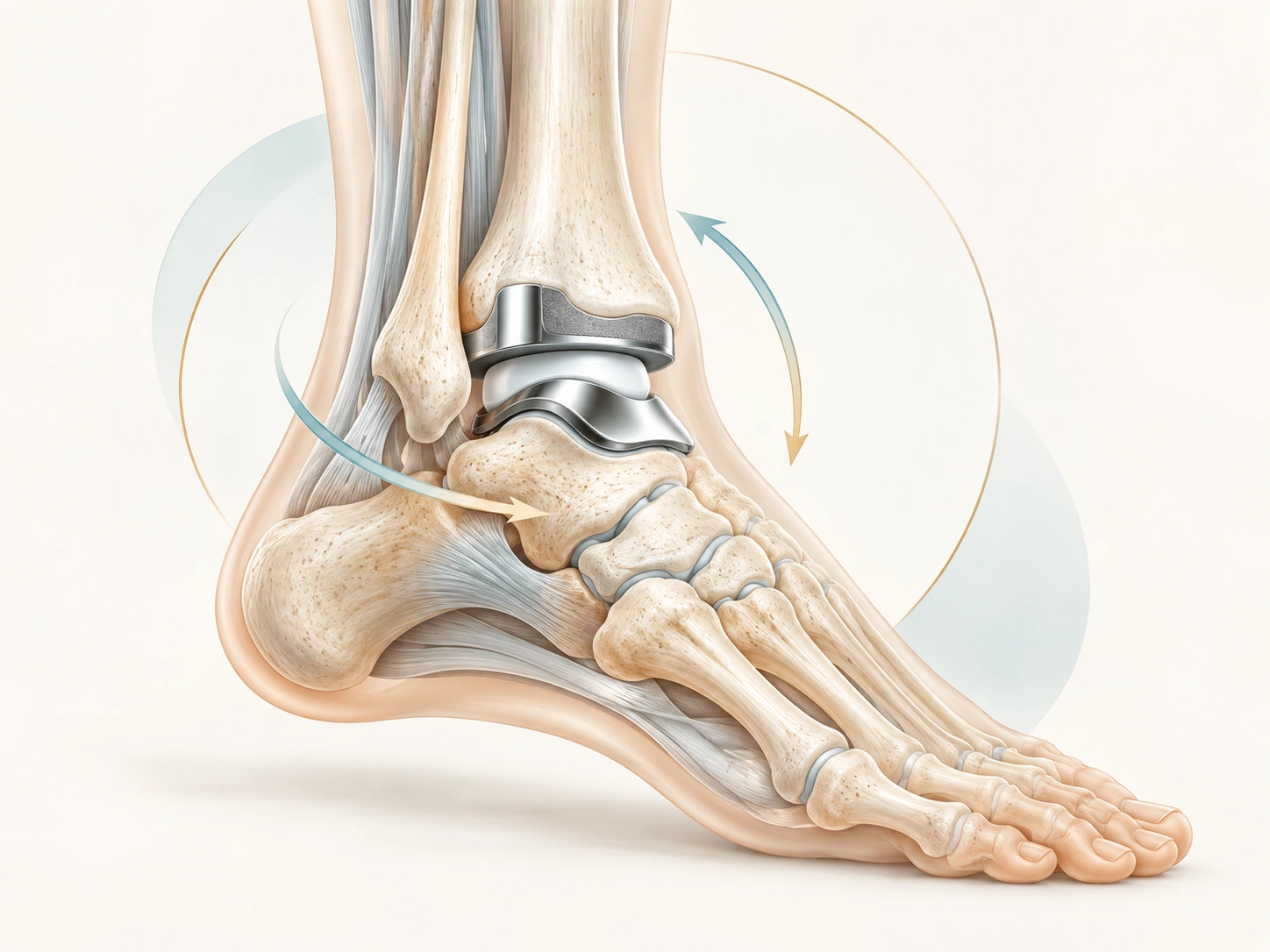
Medical illustration of total ankle replacement and PSI planning
Overview

What is a total ankle replacement?

In advanced arthritis, the cartilage that normally allows the bones to glide painlessly is severely damaged. Total ankle replacement replaces the worn joint surfaces with metal components separated by a polyethylene insert.

Unlike ankle fusion, which permanently stiffens the joint, replacement aims to preserve useful ankle motion. Its main goals remain pain relief and improved function: it does not create a 'new' ankle and does not necessarily increase range of motion.

The key ideaRelieve pain while preserving useful ankle mechanics and motion whenever possible.
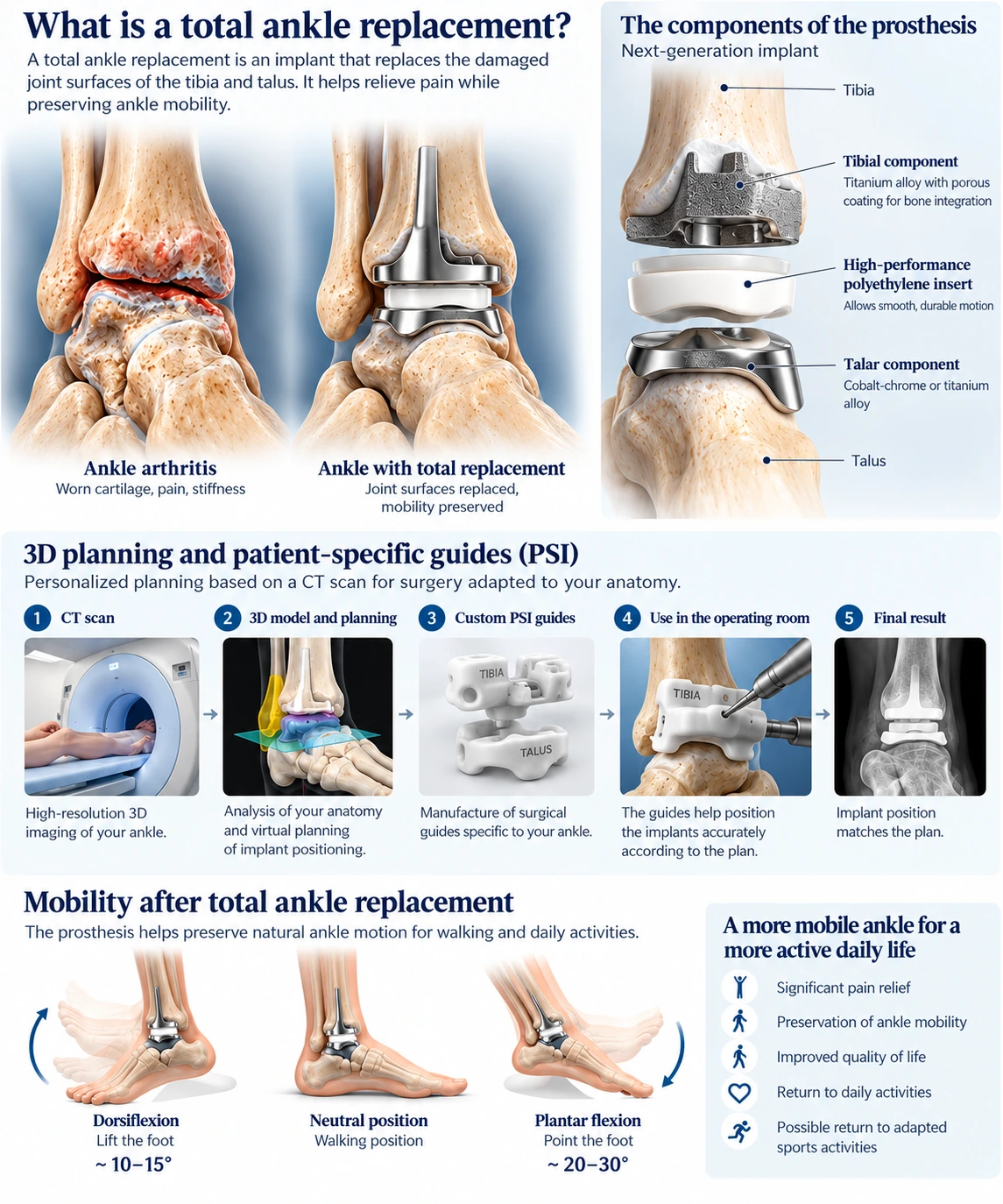
Educational infographic about total ankle replacement, its components and PSI planning
PSI

Modern planning

3D planning and patient-specific instrumentation (PSI)

With PSI — Patient-Specific Instrumentation — a pre-operative CT scan is used to reconstruct the ankle in 3D and virtually plan component size and position.

CT

CT scan using a dedicated protocol.

3D

3D reconstruction and pre-operative planning.

PSI

Patient-specific guides designed to reproduce the plan in theatre.

Check

The surgeon verifies and adapts the plan intra-operatively when necessary.

What the evidence shows

PSI is a planning and execution tool, not a guarantee of a better outcome. Studies show good reproduction of some planned parameters and reduced fluoroscopy use. However, current evidence does not demonstrate overall superior short-term clinical outcomes compared with standard instrumentation. Final implant size and position remain surgical decisions.

Indications

Why — and for whom — is ankle replacement considered?

Ankle replacement is considered when advanced arthritis causes substantial pain and functional limitation despite appropriate non-operative treatment.

It may be considered when…

  • pain is primarily arising from the ankle joint;
  • imaging shows advanced arthritis consistent with symptoms;
  • appropriate footwear, medication, physiotherapy, activity modification or injections no longer provide adequate relief;
  • preserving useful ankle motion offers a functional advantage.

It is not suitable for everyone

Active infection, significant neuropathy, inadequate blood supply, some severe bone problems, or non-reconstructible instability/deformity may preclude replacement. Very high activity demands may also favour a different strategy.

Replacement or fusion?This is not a competition between two operations. The appropriate choice depends on biological age, activity, remaining motion, alignment, bone quality, neighbouring joints and patient goals.
Goals

What benefit can reasonably be expected?

Less pain

This is the primary goal of surgery.

Improved walking

The aim is to improve walking tolerance and everyday function.

Preserve motion

Useful motion is preserved, without a guarantee of increasing pre-operative range.

The goal is generally not a return to high-impact sport. Cycling, swimming, hiking and other lower-impact activities are more compatible with long-term implant preservation.

Procedure

What happens during surgery?

Planning

Clinical and radiographic assessment, alignment evaluation and, when PSI is used, dedicated CT and 3D planning.

Anaesthesia

Surgery is performed under anaesthesia tailored to the patient; a nerve block may be added for postoperative pain control.

Joint replacement

Usually through an anterior approach, the worn tibial and talar surfaces are precisely prepared and replaced by the prosthetic components.

Balance & additional procedures

Alignment, stability and motion are checked. Depending on deformity, additional bone, tendon or ligament procedures may be required.

Recovery

Recovery: think in months, not days

Protocols vary according to implant, bone quality, wound healing and additional procedures. The milestones below are therefore general guidance, not an individual prescription.

0–2 wksProtect & reduce swelling

Immobilisation, substantial elevation, pain control and complication prevention. Weight-bearing depends on the protocol.

2–6 wksHeal & progress weight-bearing

Wound review and progression of weight-bearing when authorised by the surgeon.

6–12 wksMotion & strength

Progressive rehabilitation: motion, strength, balance and gait quality according to progress.

3–12 mosFunctional recovery

Walking and activity improve progressively. Swelling can persist for months and full recovery may take up to a year.

Risks

What are the risks and limitations?

As with any major surgery, ankle replacement carries risks. These should be discussed individually according to your health and ankle anatomy.

Wound-healing problems Infection DVT / pulmonary embolism Nerve injury or irritation Fracture Stiffness or persistent pain Wear or loosening Reoperation / revision

An ankle replacement is not permanent. Modern implants perform better than earlier generations, but wear, loosening or another complication may require further surgery during a patient's lifetime.

FAQ

Frequently asked questions

Will I be able to walk normally?

The goal is to improve walking by reducing pain. Outcome also depends on initial deformity, muscle strength, neighbouring joints and overall health.

Will replacement make my ankle more mobile?

It primarily aims to preserve useful motion. A large increase in range of motion is not guaranteed.

How long does an ankle replacement last?

There is no single lifespan for every implant. A meta-analysis of modern ankle replacements estimated overall 10-year survivorship at about 78%, but this pools different implants and patient profiles and cannot predict the lifespan of an individual replacement.

Is PSI a custom-made ankle replacement?

Not necessarily. PSI mainly means that planning and certain surgical guides are customised from the CT scan. The implanted components may still be standard implants available in several sizes.

Treatment choice

Total ankle replacement or ankle fusion: how do you choose?

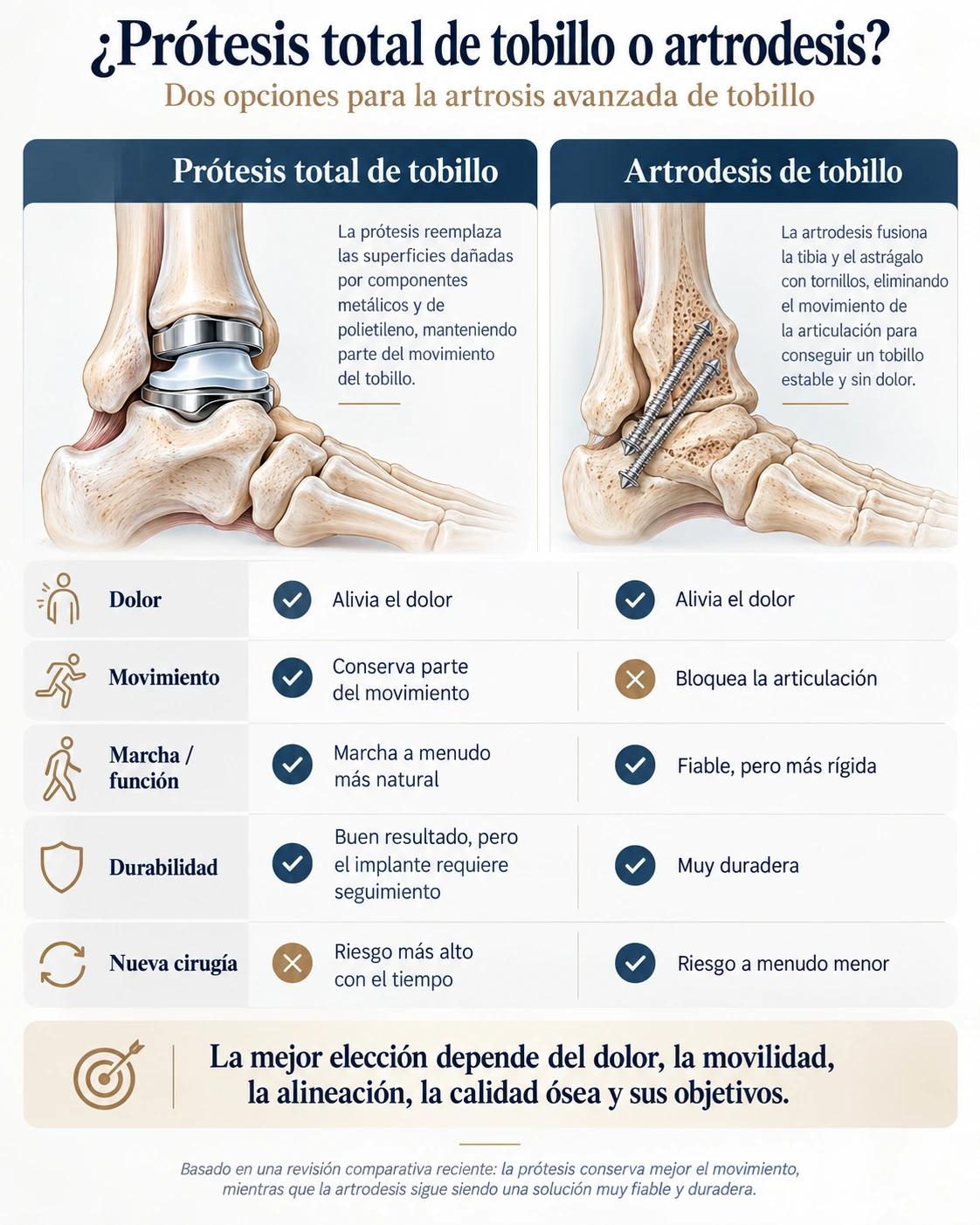
Both options can relieve pain caused by advanced ankle arthritis. Replacement aims to preserve some motion; fusion primarily aims to create a stable and durable ankle. The right choice depends mainly on your pain, mobility, alignment, bone quality and personal goals.

Comparison between total ankle replacement and ankle fusion

When replacement can be helpful

  • You want to preserve some ankle motion.
  • Walking and some activities may feel more natural.
  • You are comfortable with an implant that requires long-term follow-up.

When fusion may be preferable

  • The priority is a very stable and durable solution.
  • The ankle is too damaged, or local factors make replacement less suitable.
  • You accept losing ankle motion in exchange for high reliability.
What the review shows

Both options usually provide good pain relief.

Motion and function

Replacement better preserves motion and can provide a more natural gait in some patients.

Durability and further surgery

Fusion remains very reliable over time; replacement carries a higher chance of further surgery in the longer term.

In practice: there is no single “best” option for everyone. The best option is the one that fits your clinical situation and your goals after discussion with your surgeon.

Patient-friendly decision aid based on a recent comparative review of total ankle replacement and ankle fusion. This is general information and does not replace an individual consultation.

Selected medical sources

This page provides general patient information and does not replace individual medical assessment.

  1. St Mart JP et al. Contemporary modern total ankle arthroplasty: a systematic review and meta-analysis. The Surgeon. 2024.
  2. Tham A et al. Patient-Specific vs Standard Instrumentation in Total Ankle Arthroplasty: systematic review and meta-analysis. Foot & Ankle International. 2026.
  3. Royal National Orthopaedic Hospital. A Patient's Guide to Total Ankle Replacement. Updated 2026.
  4. Vieira Cardoso D et al. Management of ankle osteoarthritis in the young adult. Rev Med Suisse. 2021.
  5. Dubois-Ferrière V, Monsellato E, Cardoso D. La prothèse totale de cheville : mise au point. Rev Med Suisse. 2019.
  6. Total ankle replacement vs ankle fusion. Comparative analysis of outcomes, complications, longevity and cost-effectiveness. Review document provided by the author, 2026.

Helping you move forward, step by step.

A consultation is an opportunity to discuss your situation, goals and the different treatment options.

Specialist consultation

Ankle arthritis: discuss the options

The indication for ankle replacement is not decided from an X-ray alone. It depends on symptoms, clinical examination, activity, alignment and bone quality, as well as the available alternatives.